
Whales, sperm whales and dolphins are among the most charismatic marine species in the world. Humans have derived direct benefits from cetaceans for centuries. After decimating various whale populations until the middle of the 20th century, the exploitation of these species has now turned to ecotourism; tourist activities linked to cetacean watching are worth several billion euros worldwide. However, the benefits to humans of healthy cetacean populations probably far outweigh these uses.
These animals also play a little-known role in ocean mechanics and climate regulation through their production of faecal matter. This production, far from being lost, would be crucial for the recycling and transport of nutrients essential for the fertilization of the marine environment.
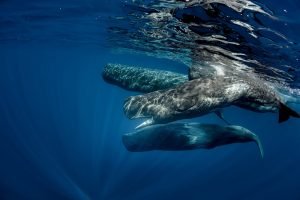
Pod of sperm whales swimming off the coast of Sao Miguel, Azores. (Credit: Adobe Stock, Willyam)
Phytoplankton, the primary producer at the base of all ocean food chains, is also a major carbon sink. The quantity of this vegetal production depends on the temperature and the nutrients available, particularly nitrogen, phosphorus, and iron. However, certain essential nutrients such as iron are locally limiting in certain ocean regions. Inputs of cetacean faeces could counterbalance these deficits and stimulate ocean productivity, thus favouring the fixation of atmospheric carbon through plankton production.
Many mesopelagic species, such as fish and cephalopods, are reservoirs of essential elements and, depending on the species, may have relatively high concentrations of certain metals such as iron or copper[1]. When these species are ingested by cetaceans at depth, the supply of these nutrients contained in the prey exceeds the physiological needs of the predators. The excess is then thrown back to the surface after digestion and released in a dissolved form that can be used directly for phytoplankton production, which in agricultural environments is similar to spreading liquid manure in the fields!
The importance of this nutrient pump from the deep waters to the surface is not yet well known, but the SUMMER project will provide exciting new data for different areas of the ocean.
Jérôme Spitz,
CNRS / La Rochelle University, France.
[1] Chouvelon, T., Munschy, C., Bruzac, S., Caurant, F., Churlaud, C., Crochet, S., … & Spitz, J. (2022). High inter-species variability in elemental composition of the twilight zone fauna varies implications for predators and exploitation by humans. Environmental Research, 204, 112379. https://doi.org/10.1016/j.envres.2021.112379



Leave A Comment
You must be logged in to post a comment.