
Arturo Castellón 1, M. Pilar Olivar 2
1 Unidad de Tecnología Marina (UTM), Consejo Superior de Investigaciones Científicas (CSIC); arturoc@utm.csic.es
2 Institut de Ciències del Mar (ICM), Consejo Superior de Investigaciones Científicas (CSIC); polivar@icm.csic.es
The organisms of the micronekton community (between 2 and 20 cm) are relatively good swimmers, and are able to avoid plankton nets. Conversely, they are too small for conventional commercial pelagic nets, which results on its extrusion through the large mesh sizes. Another feature of these organisms is that they tend to aggregate in different layers of the water column, with important differences in their vertical location through the day cycle, as denoted by images of acoustic echograms (Fig. 1).
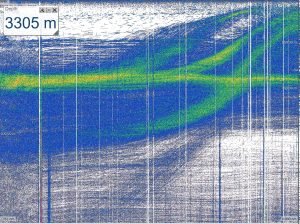
Figure 1: Different layers (as green lines) of mesopelagic organisms, observed from an echogram.
For a good depth sampling, “multi-nets” like those used for plankton, are ideal because there is no contamination of one sample with organisms of the previous sample. However for bigger nets, as those used to collect micronekton, it is more difficult to use multiple net units. In order to sample the main components of these communities (i.e. fish, crustaceans and gelatinous organisms) at different depths of the water column we developed a codend multisampler that uses a carrousel like system that was fitted to the end of a mid-size midwater trawl “Mesopelagos” (Fig. 2 and 3)).
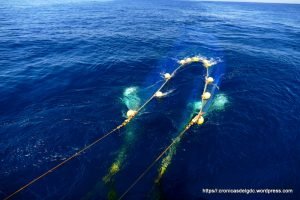
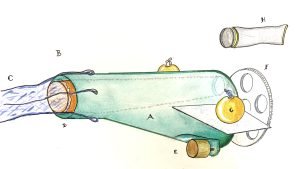
Figure 2 and 3: Above: the “Mesopelagos” trawl. Below: the VERDA multisampler device, (A) Fiber glass body. (B) Mouth. (C) Mesopelagos net. (D) Attachment. (E) Motor. (F) Plate. (G) Floats. (H) Collector (net).
Our multisampler device “The VERDA Multisampler” (Fig. 3) works similarly to some sediment traps, the system works like a revolver with 6 or 8 compartments (Fig. 4) whose turning mechanism is triggered when the net arrives to a programmed depth level. This prototype was built with cheap and recycled components and a PCB Arduino® (https://www.arduino.cc/ ) and Teensy (https://www.pjrc.com/ ) for electronic control. The vehicle was built in fibre glass, and the control unit consisted of a Technicap housing in aluminium anodized for 5000 m depth and contains the motor, the electronics, and the depth sensor (Fig. 5). The “Mesopelagos” net we used for testing the equipment has a mouth area of ca. 30 m2 , and total length of 58 m that works with a single towing cable and no doors.
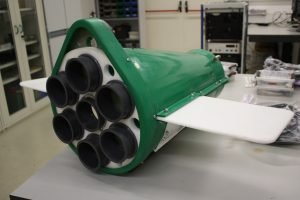
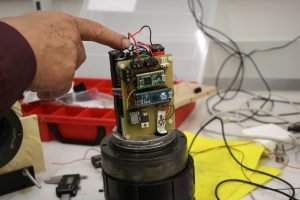
Figure 4 and 5: Above: the revolver-like compartments of the VERDA. Below: the VERDA control unit.
The overall system is very useful for all type of ships, due to the relatively easy deployment operations and because the multisampler does not need electrical cable or acoustics. In our case we use a Marport and Scanmar sensors for real time depth monitoring and opening distance measures. Trawling speed varied between 1.8 knots and 2.5 knots. As far as possible, both ship’s heading and speed were maintained constant during the operations. Hauls were carried out discriminating strata that ranged from 20 to 400 m width and from surface to a maximum of 2000 m depth, depending on the surveys particular objectives (Fig. 6).
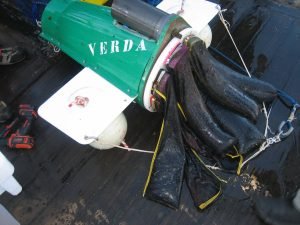
Figure 6: The multiple cod-ends (black bags) of the VERDA multisampler, filled with mesopelagic micronekton caught at different depths!
The system has been successfully used in several surveys devoted to study the diel vertical migration processes of micronekton species, and the design was presented in the publication: Castellón, A, Olivar, M.P. 2023. VERDA: A Multisampler Tool for Mesopelagic Nets. J. Mar. Sci. Eng., 11(1), 72; https://doi.org/10.3390/jmse11010072.
The use of this system, Mesopelagos + VERDA Multisampler, in combination with acoustic sampling using the on-board biological echo sounders, may be used to decide, beforehand, the layers to be sampled, and eventually to correlate the acoustic information with the biological samples. Our assessment is that the system is useful to study diversity of mesopelagic fishes, decapods and euphausiids, and that differences in vertical distribution among species and layers of the water column are well displayed from night and day stratified samples (Fig. 7).
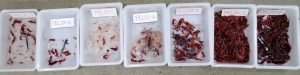
Figure 7: The catches from 7 different depths. You can observe a clear difference in the mesopelagic community based on which depth they are caught in!



Leave A Comment
You must be logged in to post a comment.