
Carbon, which is the building blocks of all living material - such as you and me, as well as fish and plankton in the sea, is continually being transported from the ocean surface into the deep. This process is known as “The Biological Carbon Pump”, consisting of multiple mechanisms which together cause the ocean to be an important carbon sink - lowering Earths CO2 levels considerably.
There are two main types of sinking particles contributing to what we call passive, or gravitational carbon flux: marine snow and fecal pellets. Marine snow mainly consists of sticky algae cells, aggregating together until they reach large enough sizes and densities to start sinking. Fecal pellets originate both from fish and zooplankton, and can be produced at depths due to diel vertical migrations. Many mesopelagic residents also feed on sinking particles, such as the Cyclothone fish, and the Vampire squid (Vampyroteuthis infernalis).
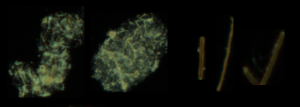
Example images of marine snow (left) and cylindrical fecal pellets (right). Cylindrical pellets are oftentimes the most numerous type, as they originate from krill and copepods.
Traditionally, particles are caught in sediment traps, where they can be analyzed in a lab for their carbon content and sinking rates. Recently, however, cameras have been shown to be an efficient method for studying these particles in situ.
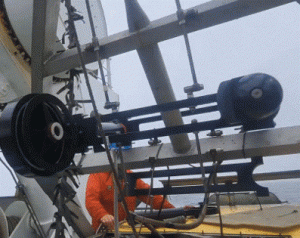
A video plankton recorder (VPR) consisting of a strobe light unit (left) positioned opposite of a microscope camera unit (right). (Photo: Kristian Fjeld)
After towing a camera (such as the VPR) at a station, we have images of thousands of particles and plankton - so how can we effectively classify them? Using machine learning has been the go-to method when working with large image datasets, and has shown great performance on VPR images, allowing us to skip the mind-numbingly dull work of classifying hundreds of thousands of images after a model has been trained.
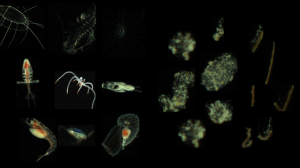
Images that the VPR has captured of zooplankton, marine snow, and fecal pellets in the Northeast Atlantic Ocean.
After the images have been classified, we need to estimate their sizes. A way of doing this is thresholding, separating the particle area from the background. When this has been done, the particle area is measured, and we can calculate the equivalent circular diameter (ECD) - which is essentially “what would the diameter of the particle be, if it was a circle?”. This is a commonly used metric for describing particle sizes.
After we have retrieved the size of each particle we can use litterature-based relationships between size and sinking rates, and size and carbon content, for each particle type. Having estimated both sinking and carbon content of every particle, total carbon flux can be calculated.
Of course, as with every method - this is not perfect. Size might not be the best explanation for sinking and carbon content, as other metrics such as composition, shape, and porosity may be just as important. This results in uncertainties of camera-based estimations of carbon flux. On the plus side, using cameras allows us to get high depth-resolved resolution data, of unhandled and undamaged particles in the ocean.
Camera methods will also likely be refined in the future with novel technologies - giving us sharper eyes in the dimly lit, and mysterious deep sea. This will allow us to uncover more of the secrets of the mesopelagic zone, its inhabitants, and the continous rain of organic material coming from above.
Text written by Kristian Fjeld (University of Bergen)

Leave A Comment
You must be logged in to post a comment.