
OBJECTIVES
SUMMER will establish a protocol to accurately estimate mesopelagic fish biomass, quantify the ecosystem services provided by the mesopelagic community (food for aquaculture, for humans, for other wild fish, climate regulation and potential for bioactive compounds) and develop a decision support tool to quantitatively balance the trade-offs between the different services for any given exploitation scenario.
The overall objective of SUMMER is to evaluate whether and how mesopelagic resources can be exploited without compromising the essential ecosystem services they provide. The specific objectives of SUMMER are:
- Determine the best combination of Methods (including submersible broad-band acoustics, environmental DNA (eDNA) and Scientific trawls) to obtain unbiased biomass and biodiversity estimates of the mesopelagic community.
- Estimate global abundance of mesopelagic fish based on a combination of the developed methods and models.
- To quantify the bycatch and impact on biodiversity of fishing (WP2).
- To measure the role of mesopelagic organisms in the vertically integrated Food web, its “service” as food for commercially fished species, deep-sea species and emblematic species and to model the effects of different fishing scenarios on trophic network stability (WP3).
- To estimate the carbon sequestration due to active migration relative to the gravitational flux and to model the effects of different fishing scenarios (WP4).
- To explore the potential of mesopelagic organisms for pharmaceutical and nutraceutical products, processed human Food and animal feed, and to evaluate the intangible value of the ecosystem for production of high-value products (WP5).
- To provide a holistic assessment of the services provided by the mesopelagic ecosystem and to establish trade-offs and tipping points between different services under different fishing harvest rates scenarios (WP6).
- To engage managers, stakeholders and society on defining strategies and Associated risks to use mesopelagic resources, proposing strategies for its sustainability (WP6 and WP7).
IMPACT
Short-term impacts for SUMMER H2020:
- Increase the knowledge of mesopelagic zone ecosystems.
- Contribute to the UN SDG 14 targets to effectively regulate marine harvesting and sustainably manage of the Paris Agreements of 2015, COP22 and UN SDG 13.
- Contribute to preserve the ecological functioning of the mesopelagic zone in line with the EU targets of halting the loss of biodiversity and ecosystem services.
- Contribute to the preservation of process regulating climate and to the mitigation of impacts of climate change.
- Foster innovation for food and nutrition Security and other biobased value chains, biodiversity preservation and climate resilience.
RESULTS
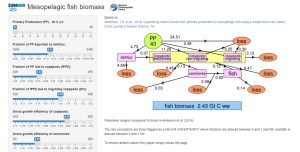
Online fish estimator model
This tool is part of the D4.3 of SUMMER (Model tools for quantifying role of mesopelagic fish in influencing the BCP) and provides a means of exploring how harvesting mesopelagic fish may impact climate regulation services by impacting the flow of carbon through the ecosystem. The user can see how changing a parameter influences the other components in response. For example, the user can explore how changing fish mortality, as a proxy for fishing, may influence the carbon fluxes to detritus and migrating copepods which represent two aspects of the climate regulation; the gravitational and active fluxes.
Access the platform https://summer-mesopelagic.shinyapps.io/summer/
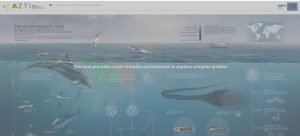
Ecosystem services trade-offs Bayesian network
Description This decision support tool (DST) is part of the D6.2 of SUMMER (A parameterized interface (Bayesian network) to determine the trade-offs and overall change in the value of the ecosystem services). The DST allows to explore the trade-offs considering uncertainties under mesopelagic fishing scenarios and different sequestration valuation approaches. It can be explored to answer “what if” in each of the fishing scenarios in relation to no fishing scenario, or the trade-offs of preservation and maximization of the value of two key provisioning species.
Access the platform https://aztidata.es/BayesNetVis/